If you have tried an AI-generated news summary, you have probably wondered at some point: is this actually accurate?
It is a fair question. AI systems make mistakes. They can misrepresent facts, conflate different events, generate plausible-sounding details that did not happen, or present contested claims as settled. These are well-documented failure modes, not edge cases. And if you are relying on a briefing to stay informed, errors are not just annoying — they can leave you genuinely misinformed, with a confident but incorrect understanding of what is happening.
So the question of whether to trust AI-generated news summaries deserves a serious answer. Not reassurance. An actual framework.
The Two Different Problems
There are two distinct ways an AI news summary can fail you, and they require different solutions.
The first is factual error: the summary states something that is not true. A date is wrong, a name is confused, a statistic is invented. These errors can be hard to spot because they are often small and specific — the kind of detail that sounds authoritative precisely because it is detailed.
The second is framing error: the summary is technically accurate but misleading. It presents one interpretation of a contested situation as though it is the only interpretation, omits key context that would change how you read the facts, or gives disproportionate weight to one source over others. This type of error is harder to detect than a factual error and potentially more damaging, because it shapes how you think about an issue without triggering the skepticism that an obvious mistake would.
Most discussions of AI accuracy focus on the first type. The second type is the more interesting problem for anyone using AI for news specifically.
What Makes AI News Summaries More or Less Reliable
Not all AI-generated summaries are the same. Several factors determine how reliable a given tool is likely to be:
Source grounding. A summary generated from a fixed set of cited sources is fundamentally different from one generated by a language model drawing on training data or an unconstrained web search. When the source documents are specified and retrievable, you can verify the summary against them. When they are not, you cannot. This is the single most important distinction between AI news tools.
Recency of the underlying information. A language model with a knowledge cutoff from last year cannot give you an accurate summary of what happened this week. Any AI news tool that does not connect to current sources in real time is not useful for news, regardless of how fluent its summaries sound.
Specificity of the task. A general-purpose AI assistant asked to summarize the news is working on a vague brief. A system designed specifically for news summarization, with structured prompts, defined source lists, and output constraints, will perform more reliably. The more constrained and specific the task, the less room there is for the model to fill gaps with plausible-sounding fabrications.
Transparency about uncertainty. Good summarization systems acknowledge when information is contested or incomplete. A summary that presents everything with equal confidence, including genuinely ambiguous or disputed claims, is a signal that the system is not handling uncertainty well.
The Verification Problem
Here is the honest tension: one of the main reasons people use AI summaries is to save time. If you have to verify every claim in a summary against the original sources, you have eliminated most of the time savings that made the tool attractive in the first place.
This is not a problem unique to AI. You face the same tension with any secondary source, from a newspaper summary to a colleague's briefing. The question is not whether you will verify everything, but whether the source has given you enough to verify the things that matter.
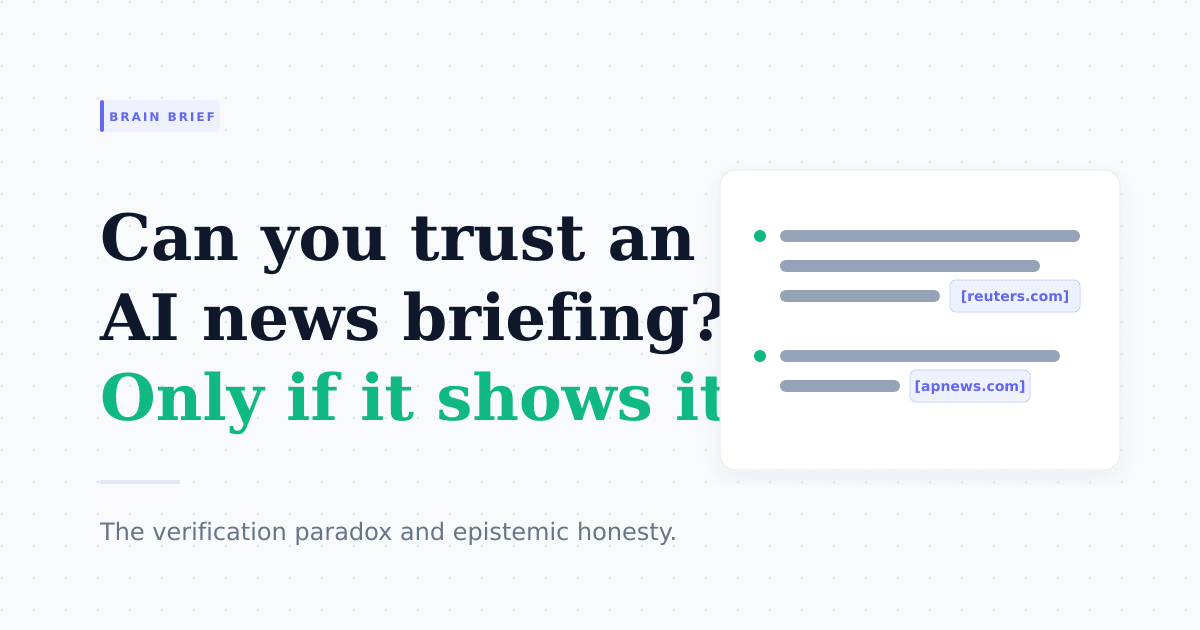
A well-designed AI news tool addresses this by making verification easy, not by eliminating the need for it. Sources should be cited inline, not buried in a footnote or omitted entirely. Claims that are potentially significant should be traceable to a specific document. The goal is not to remove your judgment from the process but to support it.
A Practical Standard
Rather than asking "can I trust this AI news tool?" in the abstract, here is a more useful set of questions:
Does it cite sources? Not just "powered by" a news provider, but specific citations for specific claims. If you cannot trace a fact back to a source document, you cannot verify it.
Can I see the sources? A citation that links to a real, readable article is meaningfully different from a reference that is hard to find or paywalled. The point is that you could check if you wanted to.
Does it cover what I actually need to follow? A source list that covers your specific topics is more trustworthy than a general news feed for your purposes. Breadth trades off against depth and specificity.
Does it tell me when it is uncertain? A tool that signals "this is contested" or "details are still emerging" is more trustworthy than one that presents everything with equal confidence. Calibrated uncertainty is a feature.
Why This Matters More Than It Used To
For most of the history of news consumption, the trust question was about editorial judgment: do you trust this reporter, this publication, this editor? That question has not gone away. AI adds a new layer: do you trust the system that is summarizing and synthesizing on your behalf?
The answer, as with any information source, is that trust should be conditional and specific. The right question is not "is AI trustworthy?" but "is this particular system, with these particular sources, for these particular topics, reliable enough for my purposes?"
For staying informed on topics that matter to your work and your decisions, the standard should be: cited sources, real-time grounding, and enough transparency that you can verify what matters. That is not a high bar. But it is a meaningful one, and not every tool meets it.
Brain Brief generates each briefing from current sources, with citations included throughout. You can read the briefing and follow the sources. That is the standard we hold ourselves to. Start your free trial at brainbrief.app.