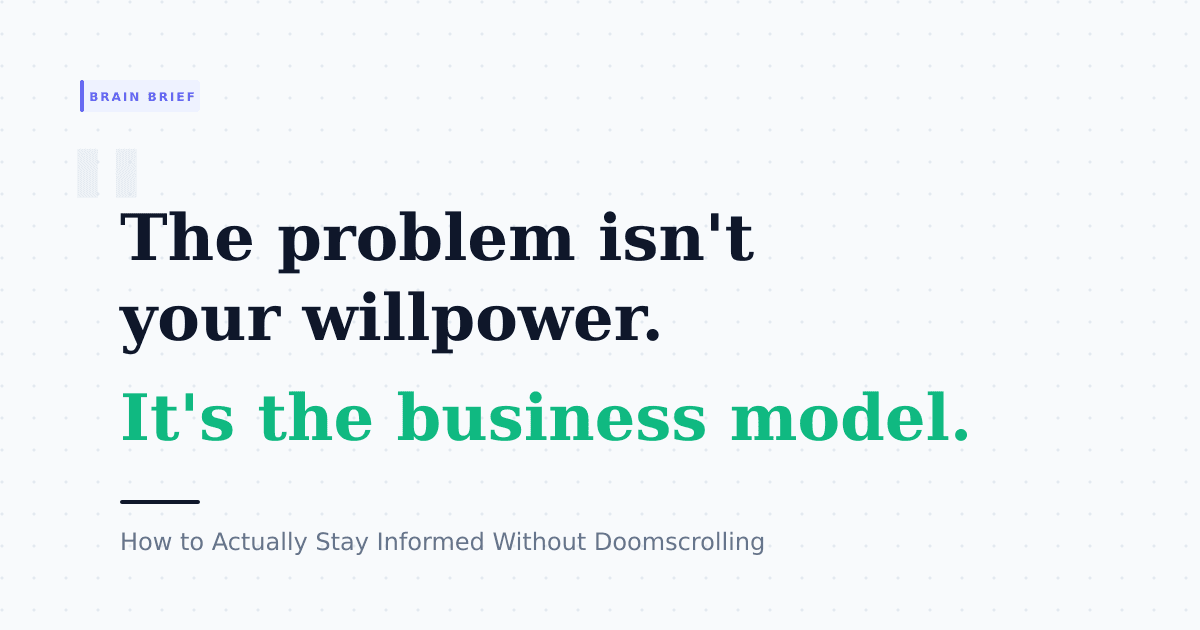
The problem isn't your willpower. It's the business model.
Every major news platform — social media, news apps, cable networks — is built around one metric: time on site. Not how informed you feel afterward. Not how accurate the information is. Not whether reading it was worth your time. Just: did you keep scrolling?
Doomscrolling is the predictable outcome of a system designed to maximize engagement at the expense of everything else. Breaking the habit requires understanding what you're actually up against, then building a different system.
Why "Just Read Less News" Doesn't Work
The instinct to quit news cold turkey is understandable. But it creates a different problem: most of us have legitimate reasons to stay informed. Our work requires it. Our interests demand it. We have a genuine desire to understand what's happening in the world.
The goal isn't to consume less information. It's to consume better information — deliberately rather than reactively.
The Real Problem: Passive vs. Active Consumption
There are two fundamentally different ways to engage with information.
Passive consumption is what doomscrolling looks like. You open Twitter or a news app with vague intentions and get pulled along by whatever the algorithm surfaces. You're not choosing what to read — the platform is choosing for you, based on what generates clicks, outrage, or fear of missing out.
Active consumption means deciding in advance what you want to know about, then finding information that serves that goal. It's the difference between wandering through a grocery store hungry versus shopping with a list.
Most people's information diet is almost entirely passive. That's by design. Passive consumption generates more engagement, and engagement is what these platforms are built to produce.
Building an Intentional Information Diet
An intentional approach to staying informed has three components.
1. Know what you actually want to follow
Not what you think you should follow. Not what's trending. What do you genuinely care about?
For most people, this is a specific mix — maybe AI developments, climate policy, their industry, a sport, and one or two personal interests. Write it down. That list is your information diet. Everything else is optional noise.
2. Schedule your news time
Open Twitter at noon, not first thing in the morning and not while waiting in line. Give yourself a defined window — 10 or 20 minutes — and close it when the time is up. The news will still be there tomorrow.
What you're doing is converting information consumption from a reactive habit (open the app when bored or anxious) into a deliberate one (read at a specific time for a specific purpose). This single change eliminates most of the anxiety that comes with passive scrolling.
3. Favor synthesis over links
The format matters as much as the content. A well-written summary of what's happening in a topic — with context and significance explained — is worth more than ten raw links you'll open and never finish reading.
Aggregation feels informative. Synthesis actually is.
This is also why email works better than feeds for intentional consumption. An email arrives, you read it, you close it. There's no infinite scroll. The format enforces a natural stopping point.
What "Staying Informed" Actually Means
It's worth examining what this phrase means in practice.
Most people who doomscroll feel perpetually busy with information but persistently unenlightened. They can tell you what the latest controversy was but not why the Federal Reserve's latest decision matters for their mortgage rate. They're consuming volume, not depth.
Being genuinely informed means having enough context to understand what's happening and why it matters. That requires consistent engagement with a specific set of topics — not a firehose of everything.
Narrower scope, read more carefully, actually retained: that's what staying informed looks like.
A Better Design
The alternative to doomscrolling isn't less information — it's better-designed information delivery. A daily briefing that covers only the topics you've chosen, arrives in your inbox on a fixed schedule, and synthesizes rather than aggregates does something algorithmically driven platforms fundamentally cannot: it serves your agenda instead of the platform's.
You read it, you're done. Nothing to scroll. No recommendation engine designed to pull you deeper.
That's the philosophy behind Brain Brief. Choose your topics. Get a briefing. Move on with your day.