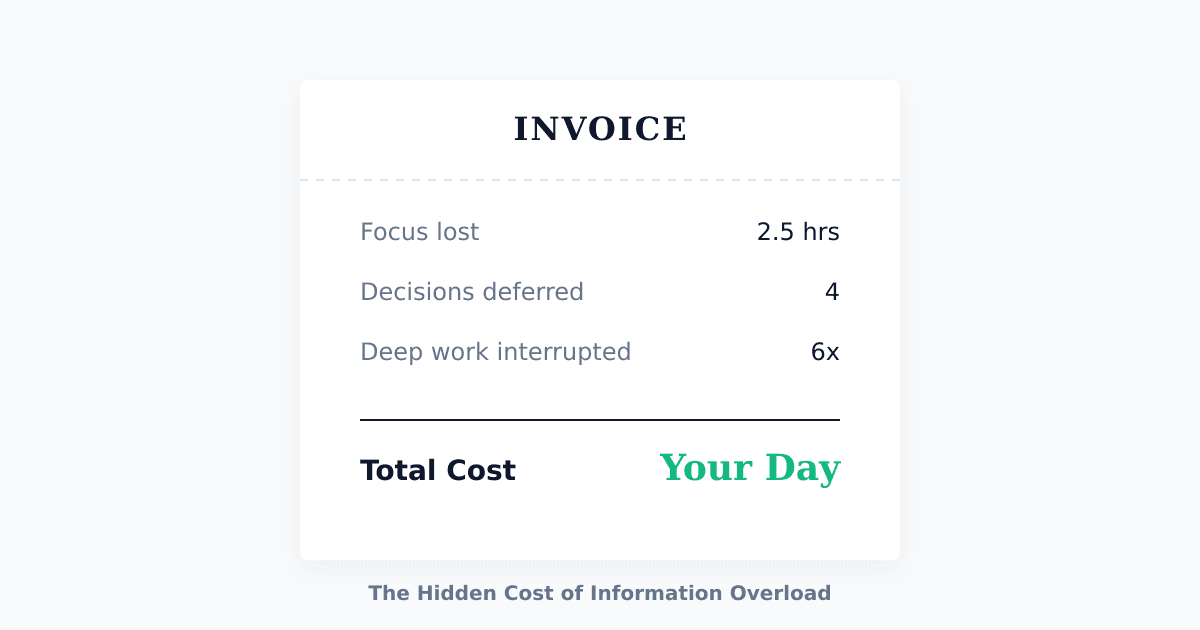
Every knowledge worker has experienced some version of this: you spent the morning reading — news, newsletters, Slack, email, a few articles you meant to skim — and by noon you feel both exhausted and somehow behind. You've been consuming information for hours. You don't feel more informed.
This isn't a personal failing. It's a well-documented cognitive phenomenon, and it has real consequences.
What Information Overload Actually Is
Information overload happens when the volume of incoming information exceeds a person's capacity to process it meaningfully. The concept isn't new — psychologist George Miller established in 1956 that the human brain can hold roughly seven pieces of information in working memory at a time. What's new is the scale of the problem.
The average knowledge worker in 2024 encounters more information in a single day than a person in the 15th century encountered in a lifetime. This isn't metaphor — it's a rough estimate from information scientists who study data volume growth. The biological machinery hasn't changed. The information environment has changed dramatically.
The result is a system under consistent stress — not the dramatic, acute stress of a deadline, but the chronic, low-grade stress of a brain that is perpetually processing more than it can meaningfully absorb.
The Attention Recovery Problem
The most cited piece of research in this area comes from Gloria Mark at the University of California, Irvine, who has spent decades studying how people actually work. Her findings are consistently uncomfortable.
After an interruption — switching to a different app, checking a notification, clicking a link — it takes an average of 23 minutes to return to full focus on the original task. Not two minutes. Twenty-three.
For knowledge workers who check news or social media habitually during the workday, the math is sobering. Three interruptions from a news feed between 9 and 11 AM might cost more than an hour of productive cognitive bandwidth — not in the time spent on the interruption, but in the recovery time afterward.
This compounds in a specific way when the interruption is information designed to generate an emotional response. Outrage, anxiety, and urgency are the emotional signatures of most news feeds — and these states are particularly disruptive to the kind of focused, analytical work that high-performance knowledge work requires.
The Decision-Making Degradation
A second, less discussed cost is what information overload does to decision quality.
Research from Columbia Business School and other institutions on "decision fatigue" has established that the quality of decisions degrades as cognitive load accumulates throughout the day. Judges grant parole at different rates before and after lunch. Doctors prescribe more conservatively late in a clinical session. The brain, treated as a resource, runs lower as the day progresses.
Information overload accelerates this. Exposure to high volumes of competing information — each piece implicitly demanding a response (Is this important? Should I act on this? What does this mean for me?) — consumes the same decision-making resources that you need for the actual work of your job.
The professional who spends an hour reading a fire-hose of news before sitting down to make a strategic recommendation is operating at a cognitive disadvantage relative to the one who did something structured and finite instead.
The Retention Paradox
Perhaps the most counterintuitive cost: more information often means less learning.
This is the retention paradox of information overload. Humans consolidate memories during sleep, and the brain preferentially consolidates information it processed deliberately and with some depth. Surface-level exposure to high volumes of information — the scrolling-and-skimming pattern — produces weak memory traces that fade quickly.
The professional who reads twelve headlines about a geopolitical development will likely retain less about that situation in two weeks than the one who read one well-synthesized 600-word briefing. Volume is not depth. Speed is not retention.
This is why people who follow a lot of news often find themselves unable to explain, in substance, what's actually happening in the stories they've been "following."
What It's Costing, Concretely
The IDC estimated that the annual cost of information overload to the US economy was over $650 billion — a figure that accounts for lost productivity, poor decisions made under cognitive strain, and the time cost of managing information overload itself.
At the individual level, the costs are less dramatic but more personal:
- Chronic background anxiety — the persistent sense that you're behind, missing something, or insufficiently informed
- Reduced strategic thinking — shallow, reactive thinking rather than the kind of deliberate analysis that produces good work
- Meeting performance — showing up to discussions with ambient awareness rather than genuine command of relevant topics
- Career signaling — colleagues and managers notice the difference between someone who speaks with genuine understanding and someone who is working from headlines
A Different Approach
The solution isn't to stop engaging with information. It's to redesign how you engage with it.
The core shift is from passive to deliberate consumption: knowing what topics you want to follow, choosing a format that synthesizes rather than aggregates, and creating fixed windows for information consumption rather than continuous ambient exposure.
A daily briefing that covers exactly the topics you've chosen — read once, at a consistent time, in a format that gives you genuine understanding rather than a pile of links — addresses the core problem. It keeps you genuinely informed on the things that matter to your work and your interests, without the cognitive costs that come with passive, high-volume consumption.
The goal isn't to be less informed. It's to be actually informed, rather than just busy with information.