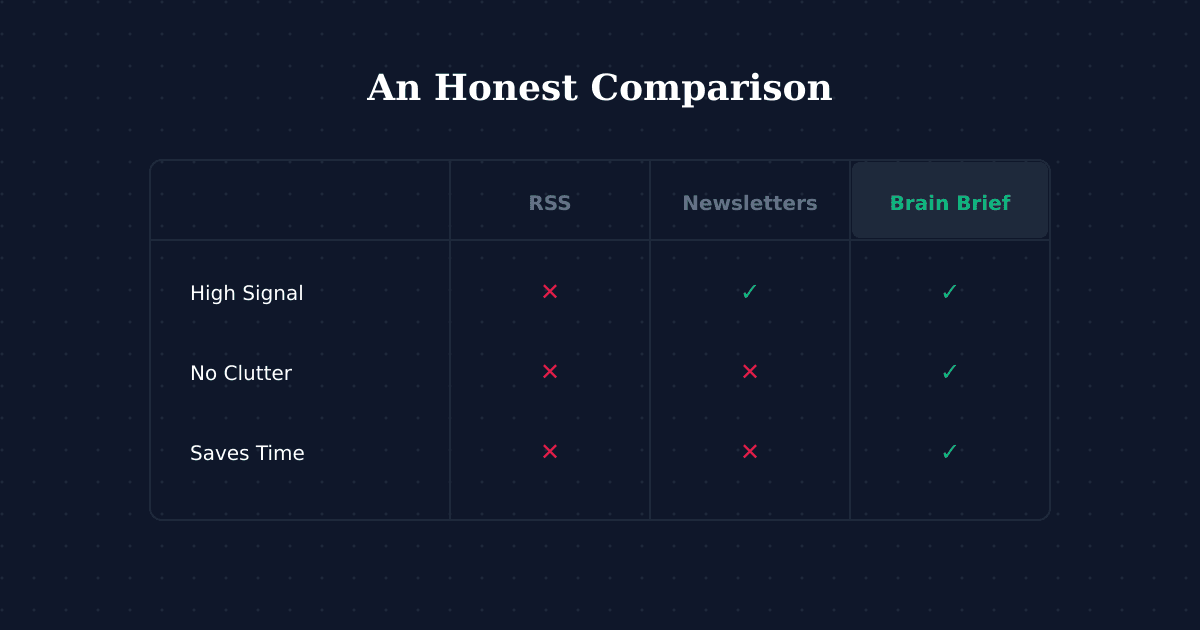
There is no shortage of tools that promise to help you stay informed. After two decades of media experimentation, the options have proliferated: RSS readers, curated news apps, Substack newsletters, email digests, Twitter lists, Reddit, podcasts, and now AI-powered briefings. Each has a committed user base that insists it's the right approach.
Most of them work, for some people, in some situations. None of them is right for everyone.
Here's an honest assessment of each major approach — what it's genuinely good at, where it falls short, and who it tends to serve best.
RSS Feeds
What it is: RSS (Really Simple Syndication) is a protocol that lets you subscribe to websites and get new posts delivered to a feed reader like Feedly, NewsBlur, or the late, beloved Google Reader. You build your own curated list of sources and read everything in one interface.
What it does well:
- Complete control over sources — nothing algorithmic, nothing you didn't choose
- Works across thousands of publications and blogs
- Chronological and predictable — you see everything, in order
- Great for niche or technical publications that aren't available in mainstream apps
Where it falls short:
- Source-first by nature: you follow publications, not topics. If a major story crosses multiple sources you don't follow, you'll miss the synthesis.
- No significance filtering — you see every post from every subscribed source, regardless of importance
- High maintenance: requires active curation, and lists go stale as publications change
- Doesn't work with Twitter, Substack (by default), or many modern content platforms
- The reading experience depends entirely on your reader app
Best for: Developers, researchers, and niche-domain professionals who know exactly which sources cover their field, and want to see everything from them without algorithmic interference.
News Apps
What they are: Curated aggregators like Apple News, Google News, Flipboard, and their equivalents. These pull from thousands of publishers and use algorithms (with varying degrees of editorial curation) to surface what's considered relevant to you.
What they do well:
- Zero setup — they work immediately
- Broad coverage across many publishers
- Good for casual, general-interest consumption
- Mobile-optimized for reading on the go
Where they fall short:
- Algorithmic by nature: what surfaces is what drives engagement, not what's most substantive
- Designed for time-in-app maximization — infinite scroll, constant fresh content
- Topics and personalization are coarse; you can say "I like tech news" but not specify the precise intersection of AI, climate policy, and Formula 1 you actually care about
- You're reading within the app, not a format that enforces closure
Best for: General-interest news consumers who want a passive, low-effort way to catch major stories across categories. Not ideal for anyone who has specific professional or niche interests they want to follow with depth.
Newsletters
What they are: Email publications from individual writers or publications, delivered directly to your inbox. The modern newsletter boom (Substack, Beehiiv, Ghost) created thousands of high-quality independent publications across nearly every topic.
What they do well:
- Direct relationship between writer and reader — no platform intermediary
- Often the highest-quality writing in a given domain, from experts writing in their own voice
- Email format naturally enforces closure (you read it, you're done)
- Delivered on a predictable schedule
Where they fall short:
- Bundle problem: each newsletter covers its own scope, and you take all of it or none
- Volume: most readers subscribe to far more than they can meaningfully read
- Source-first: you're following a writer's perspective on a topic, not the full landscape of what's happening
- Inconsistent publishing schedules create noise management problems
- Quality varies enormously — the great ones are irreplaceable, the mediocre ones become inbox guilt
Best for: People who have found specific writers they trust deeply in domains they care about. Works best when paired with genuine selectivity (two or three, not fifteen).
Social Media (Twitter/X, LinkedIn, Reddit)
What it is: Follows, lists, communities, and algorithmic feeds across social platforms, used as an information source rather than (just) a social network.
What it does well:
- Real-time coverage — often the fastest source for breaking developments
- Expert commentary and primary source discussion (especially Twitter/X for certain fields)
- Reddit communities offer deep, niche expertise on specific topics
- Social signal — you can often gauge significance by how much credible people are discussing something
Where it falls short:
- Engineered for engagement, not understanding — the format rewards hot takes over nuanced analysis
- High noise-to-signal ratio, even with careful curation
- Optimized for time-in-platform, not information efficiency
- Emotionally expensive — platforms designed to keep you engaged often do so through outrage and anxiety
- No synthesis: you get fragments, not coherent understanding
Best for: Real-time monitoring of fast-moving situations; following specific experts in narrow domains; understanding the conversation around a topic rather than the topic itself. Not a substitute for synthesis.
AI-Powered Briefings
What they are: Services that use AI to synthesize what's new and significant in a given topic area, then deliver the result as a readable briefing — rather than surfacing links or aggregating headlines.
What they do well:
- Topic-first rather than source-first: finds relevant coverage across all sources, not just ones you curate
- Synthesis over aggregation: you get coherent understanding, not a pile of headlines
- Works across any combination of topics, regardless of how niche or multidisciplinary
- Finite format — a briefing is a document, not a feed
- Scales to exactly what you care about without the bundle constraints of newsletters
Where they fall short:
- Significance filtering is still imperfect — determining what's genuinely new and important versus high-volume noise is a hard problem
- Not suitable for real-time: if you need to know about something the moment it happens, a daily briefing won't serve that need
- Quality depends heavily on the underlying model and curation logic
- The category is new, and the best implementations are still being refined
Best for: People with specific, defined topic interests who want genuine understanding — not ambient awareness — in a time-efficient format. Particularly well-suited to professionals who need to stay current on their industry and a few other areas without the time cost of managing multiple information sources.
Building Your Stack
These tools aren't necessarily mutually exclusive. A practical information diet for most knowledge workers might look like:
- One or two deeply trusted newsletters from writers who are genuinely expert in your most important domain
- Twitter/X lists or Reddit communities for real-time signal in fast-moving topics, accessed on a schedule rather than continuously
- A daily briefing for the rest — the topics you want to follow without the curation overhead
The goal is deliberate design. Most people's information diet happened to them; they subscribed to things, followed accounts, and opened apps reactively. The alternative is deciding what you want to know about and choosing the tools that serve that goal.