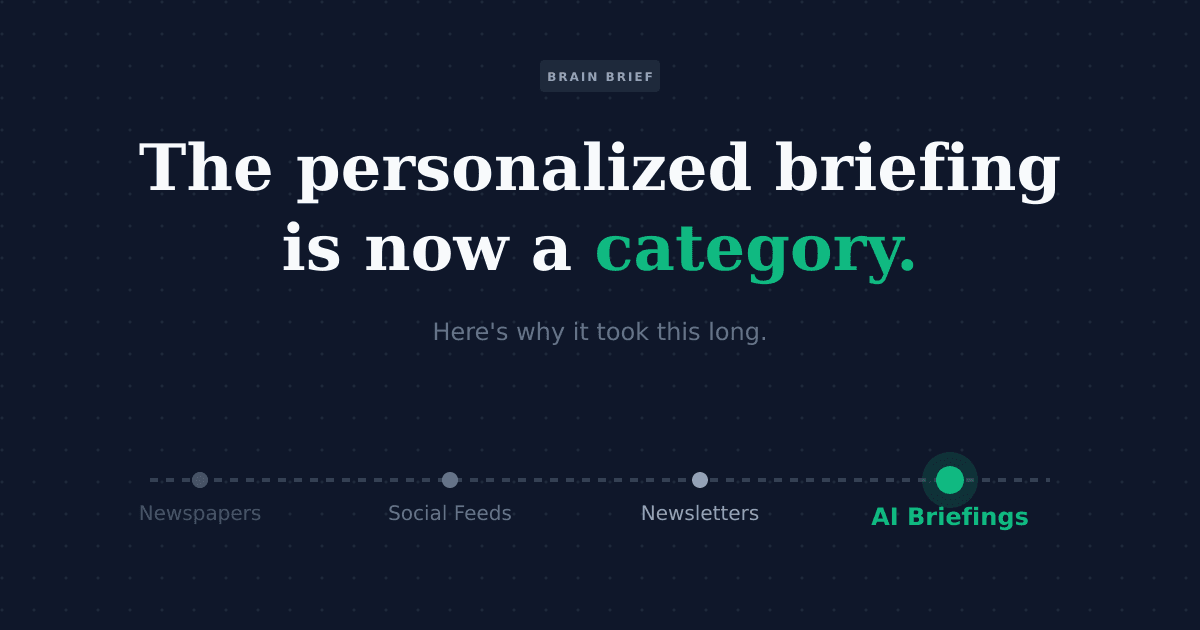
Something quietly significant happened in the news industry at the beginning of 2026.
OpenAI launched Pulse, a card-based briefing that ties directly to your ChatGPT conversation history. Perplexity began rolling out personalized news summaries through its Comet browser. Huxe — built by engineers who previously worked on Google's NotebookLM — launched an audio briefing that synthesizes your email, your interests, and the day's top news into a single daily delivery.
Three major products. Three different approaches. All pointing at the same thing: the personalized briefing is now a category.
If you follow the media or AI industries, you might have noticed this and moved on. But it's worth pausing on. These companies don't build products because they have spare engineering capacity. They build products because they've identified a problem that a large number of people have and that existing solutions aren't solving well.
The problem, in this case, is one most of us know firsthand. We are drowning in information and starving for understanding.
Why the Old Models Stopped Working
For most of the 20th century, staying informed was a logistics problem. Information was scarce and expensive to distribute. Newspapers, radio, and television solved this by aggregating news and broadcasting it to everyone at once. The format worked because there wasn't an alternative.
The internet changed the logistics. It made information nearly free to produce and distribute. The problem it created — one we're still reckoning with — is that it didn't change the incentive structure of how information gets made.
Attention became the currency. The systems built to capture it — social media feeds, infinite scroll, push notifications, algorithmically ranked headlines — were optimized for engagement, not understanding. A story that makes you anxious performs better than a story that makes you informed. A headline that provokes outrage gets more clicks than one that provides context.
The result is a media environment that is, in aggregate, technically fuller of information than any in human history, and also somehow less useful for most people than a good newspaper was in 1985.
The Newsletter Detour
The first serious attempt to escape this was the newsletter renaissance of the early 2020s. Substack, Beehiiv, and a dozen similar platforms made it easy for individual writers to publish directly to an audience's inbox, bypassing the algorithmic feeds entirely.
It worked — for a while, and for some people. The best independent newsletters found real audiences. The inbox, at least in theory, was a quieter place than the feed.
But the newsletter model carried a structural problem with it: newsletters are written for everyone who subscribes, which means they're optimized for no one in particular. A technology newsletter covers AI, policy, startup culture, hardware, and founder profiles. A given reader might care deeply about two of those things and have zero interest in the rest. The newsletter doesn't know the difference. It delivers everything, and readers end up skimming, guilt-reading, or quietly unsubscribing.
The volume problem returned, just more slowly. The average person who subscribed enthusiastically to newsletters in 2021 has a graveyard of unread digests in their inbox by 2026.
Why Personalization Is the Logical End State
If you step back and ask what people actually want from a news product, the answer is surprisingly consistent: they want to know what's happening in the topics that matter to them, synthesized well enough that they can understand it quickly, without having to wade through everything else.
This is not a new desire. It's roughly what a well-read friend with relevant expertise could give you, if you could call them every morning.
For a long time, building that at scale was technically impossible. General-purpose AI models weren't good enough at synthesis and summarization to produce output worth reading. The infrastructure to personalize content delivery at the individual level was expensive and complex.
Both of those constraints have now effectively collapsed.
Which is why, in early 2026, you're watching OpenAI, Perplexity, and a team of former Google engineers all build versions of the same thing simultaneously. Not because they're copying each other — most of these products were in development in parallel — but because they're all responding to the same structural shift.
What Changes Now
For readers, this is straightforwardly good news. The personalized briefing category is young, which means the products are still rough around the edges. But the underlying premise — that your daily information intake should be curated to your interests, synthesized by something that can actually process the volume of news being published, and delivered in a format that respects your time — is now being validated by some of the best-funded engineering teams in the world.
The questions worth asking when evaluating any of these products are practical ones:
- Is it synthesizing, or just summarizing? (A good briefing draws connections across sources. A weak one just shortens headlines.)
- Does it cite sources? (Synthesis without attribution is how misinformation travels in a polished wrapper.)
- Can you actually control what it covers? (The value of personalization depends entirely on how specific you can be.)
- How long does it take to read? (The briefing that takes 30 minutes has solved a different problem than the one that takes 5.)
The Bigger Picture
There's a useful frame for understanding what's happening here. Google Search traffic has declined roughly 33-38% globally over the past year. The "search, click, read, understand" chain that powered most online publishing for two decades is shortening. People are asking AI systems directly and getting synthesized answers rather than lists of links to open in tabs.
The homepage is not dying. But it is becoming one option among many, rather than the default path to information.
The morning briefing — personalized, synthesized, delivered to you — is emerging as one of the main alternatives. Not because it was invented this year, but because the technology finally caught up to the concept.
Two decades of information overload, a global pandemic that accelerated news consumption habits, the maturation of large language models, and the collapse of traditional distribution paths all point at the same conclusion: the way most people stay informed is about to change significantly.
The category is real. The timing is now.
Brain Brief delivers a personalized daily briefing on the topics you choose. Takes about five minutes to read. Start your free trial.