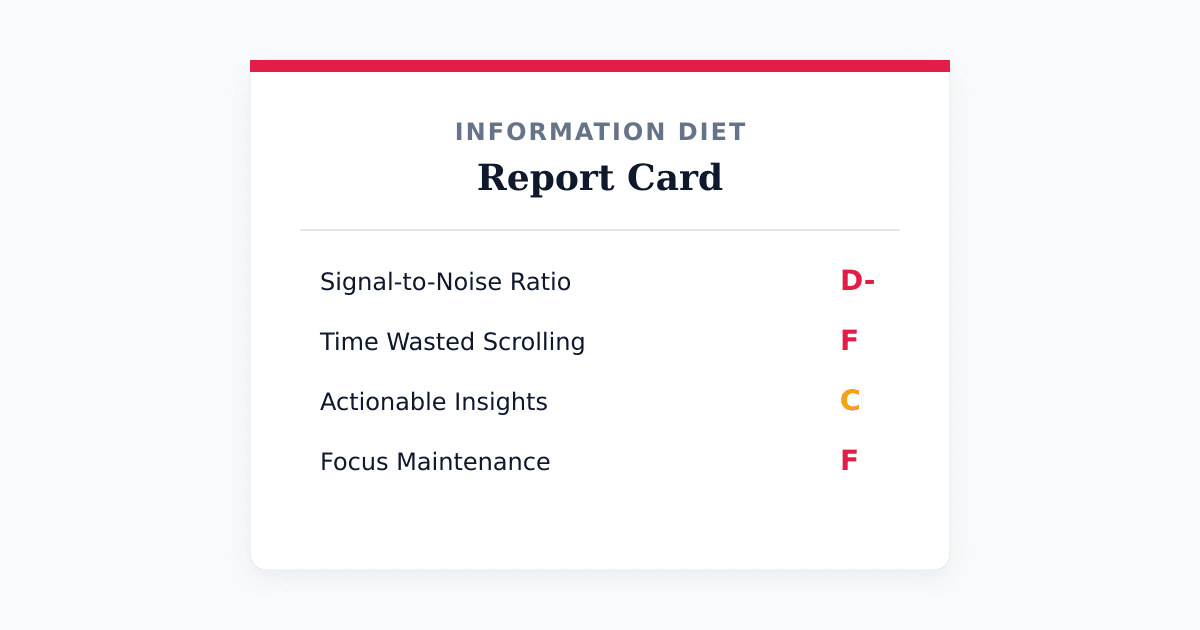
There's a version of staying informed that looks like staying informed but produces almost none of the benefits. You're reading constantly. You have opinions on current events. You could name the relevant parties in most major stories if pressed.
But if someone asked you to explain — actually explain, not just gesture at — what's happening in any of the topics you "follow," you'd find yourself reaching for phrases that sound informed without saying much. "It's complicated." "There's a lot going on." "I've been following it."
The difference between feeling informed and being informed is substantial. Here are five signs you've drifted toward the former.
1. You Have Tabs Open You'll Never Read
You know the ones. Opened with intention ("I'll read this later"), now forming an archaeological record of your reading ambitions going back weeks. Some of them might actually be interesting. You've forgotten why you saved them.
This is the visible symptom of a structural problem: you're encountering more content than you can meaningfully process. The tabs aren't a personal failing — they're a sign that your information intake is exceeding your capacity for actual reading.
The right question isn't "how do I get through my reading list?" It's: why does a reading list keep accumulating? The answer is usually that you're subscribing to more, following more, and opening more than you have time to genuinely engage with. The tabs are the overflow.
A well-designed information diet doesn't accumulate overflow. It matches what you consume to what you can actually absorb.
2. You Feel Informed But Can't Explain Things in Substance
Test yourself honestly: pick one topic you "follow" and try to explain it to someone who knows nothing about it. Not the names of the players, not that it's "a big deal" — the actual substance. What's happening? Why? What changed recently and why does it matter?
If the explanation stalls quickly, you have recognition without recall. You've been exposed to the information. You haven't processed it into understanding.
This is extremely common among people who consume high volumes of news. The format they're consuming — headlines, brief articles, social media posts — is optimized for surface-level familiarity, not for building genuine understanding of a topic over time.
Being able to explain something clearly is the real test of whether you've absorbed it. Most heavy news consumers fail this test on most of the topics they think they follow.
3. Reading the News Makes You More Anxious, Not Clearer
Information, consumed well, should produce a sense of understanding — an increased ability to make sense of what's happening and why. If your news consumption is consistently producing anxiety, dread, or a sense of being overwhelmed, the format and the content are working against each other.
This is by design in most news and social media environments. Platforms are optimized for engagement, and the emotional states that drive engagement are not the same ones that produce clear thinking. Anxiety, outrage, and urgency are effective at keeping you scrolling. They're not effective at helping you understand the world.
The tell is how you feel when you finish reading. Informed, calm, and ready to move on? Or more activated, more vaguely aware of bad things happening, and somehow less certain than before you started?
The latter is a sign that your information environment is working on you, not for you.
4. You Subscribe to More Than You Read (And Feel Guilty About It)
Newsletter subscription guilt is a specific, widely shared experience. The publications you subscribed to with genuine intention, which now arrive in your inbox as accumulating reminders that you're behind. The podcasts in your queue with 47 unplayed episodes. The RSS reader with 300+ unread items.
The guilt itself is a diagnostic. It means your stated interest in being informed — your aspirational information diet — and your actual behavior are misaligned. You believe you should be reading these things. You don't have the time or attention to actually read them.
The solution isn't more discipline. It's a smaller, better-chosen set of sources that you actually engage with rather than a larger set that you aspire to. Unsubscribing from things you don't read isn't falling behind. It's being honest about what you'll actually consume.
The information that matters to you — the topics you genuinely care about — deserves actual attention, not aspirational subscription.
5. You Know What Happened, But Not Why It Matters
This is the subtlest sign, and the most important one.
There's a difference between being aware of events and understanding them. Awareness tells you that something happened. Understanding tells you why it happened, what it changes, and what comes next. The former is easily obtained from headlines. The latter requires context, continuity, and synthesis.
Most information consumption produces awareness. Very little of it produces understanding.
The tell: when a topic you follow comes up in conversation, can you contribute to the discussion — offer context, explain the background, make sense of what it means — or can you only confirm that yes, you heard about that?
Genuine understanding of a topic accumulates over time through consistent, synthesized coverage. A briefing that explains what changed and why it matters — not just what happened — builds this kind of understanding. Headlines confirm that you've heard of something. Synthesis teaches you to actually know it.
What to Do About It
None of these signs require dramatic interventions. They're all pointing at the same underlying problem: the format and volume of your information consumption isn't matched to the goal of actually being informed.
The fix is to be deliberate about what you follow, choose formats that synthesize rather than aggregate, and create finite consumption habits rather than continuous ones.
Less, better understood, on the topics that actually matter to you.