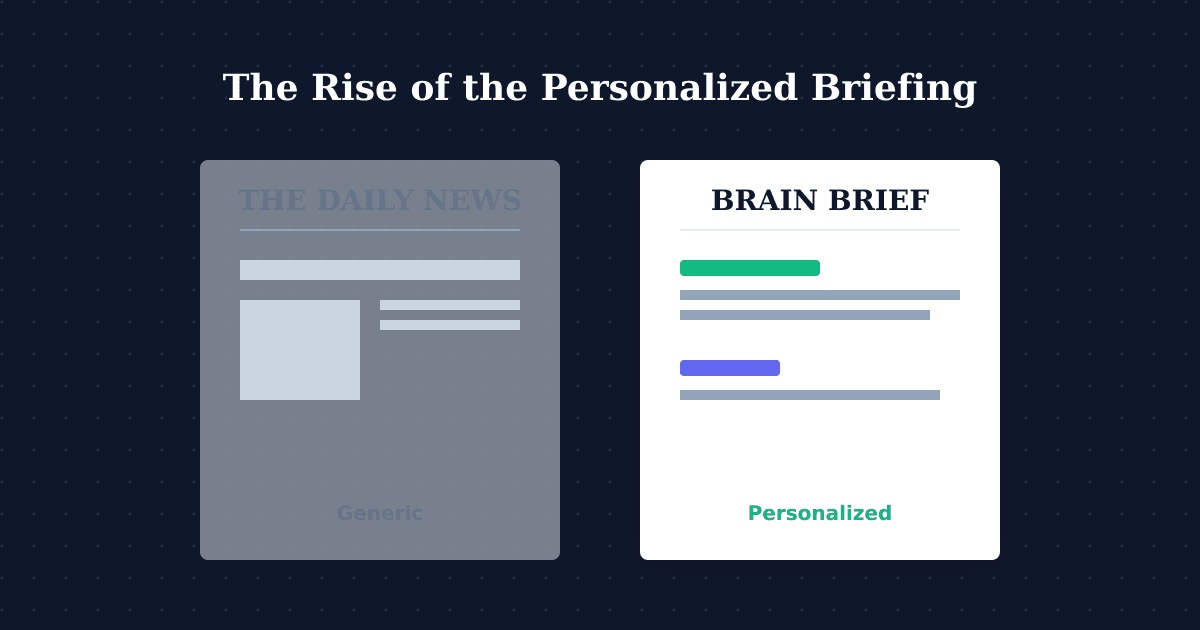
For most of the twentieth century, staying informed meant reading the same thing as everyone else.
The morning newspaper was a genuinely shared experience. The same front page reached millions of households simultaneously. People in a city read the same stories, formed opinions from the same editorial framing, and carried the same set of facts into their day. The information was generic by design — one publication, one audience, one version of what mattered today.
This worked, for a long time, because the alternative was nothing. A personalized newspaper was technologically impossible and economically absurd. You took the bundle or you went uninformed.
The last thirty years have been a steady unwinding of that constraint — each step getting closer to information that actually fits the person receiving it, each step also creating new problems the previous step didn't have.
The First Fragmentation: Cable and Niche Media
The first significant move away from universal information delivery came with cable television and the proliferation of niche publications in the 1980s and 90s. Instead of one news broadcast that everyone watched, you could watch a channel dedicated to sports, or business, or politics.
This was genuine progress: you could specialize. A person who deeply cared about financial markets could get more coverage, at greater depth, than a general newspaper could provide.
The drawback was coarseness. Channels and publications still served broad audiences — "business news" rather than the specific intersection of private equity and healthcare that a particular reader actually wanted. And the partisan segmentation that cable news introduced — selecting your channel partly based on how it would frame the news — introduced a different kind of distortion.
You got more choice. You didn't get your choice.
The Social Media Era: Algorithmic Personalization
The promise of social media platforms was something closer to true personalization. By learning from your behavior — what you clicked, what you lingered on, what you shared — the algorithm would surface exactly what was relevant to you.
In practice, it optimized for something else: engagement. The algorithm that maximizes your time on platform and the algorithm that serves your genuine informational interests are not the same algorithm. The former surfaces outrage, controversy, and novelty. The latter would surface careful analysis of the topics you care about, even when that analysis is less emotionally activating.
Social media platforms built the personalization infrastructure. They pointed it at the wrong goal.
The result was feeds that felt personal — they were full of things you'd responded to before — but produced neither genuine understanding nor the sense of being well-informed. They produced the sense of being very busy with information.
The Newsletter Era: Human Curation
The reaction against algorithmic curation drove the newsletter boom of the early 2020s. The argument was that a trusted human editor, writing for a self-selected audience, would produce better signal than any algorithm.
This was partly right. The best newsletters — written by genuine experts for audiences who chose them deliberately — offered something no feed could: consistent quality, a coherent perspective, and the trust that comes from a real relationship between writer and reader.
The limitation was structural. Even the best newsletter serves a defined audience with a defined scope. It's still a bundle: you subscribe to a technology newsletter and you take all its technology coverage, whether or not the specific mix of topics it emphasizes matches yours.
The newsletter era gave readers human curation. It didn't give readers their curation.
The Next Step: Topic-Level Personalization
True personalization — the kind where the information you receive is actually built around your specific interests, not your demographic or your behavioral footprint — requires a different approach.
It requires starting with the reader's stated interests, not the publication's scope. It requires finding coverage across all sources, not just the ones a single writer follows. And it requires synthesizing that coverage into something readable, rather than presenting a feed of links and leaving the work of understanding to the reader.
This is what AI makes possible at scale. Not because AI can replace the judgment of a good editor — it can't — but because AI can do something no human editorial operation can: read across thousands of sources, identify what's actually new and significant in a specific topic on a specific day, and produce a coherent, readable summary of it. For any topic, at any intersection of interests, for any individual reader.
The result isn't a newsletter, and it isn't a feed. It's closer to the briefing memo that chiefs of staff have written for executives for decades — a synthesized document that covers what matters, tailored to the recipient, designed to produce genuine understanding rather than ambient awareness.
What This Means for How We Stay Informed
The arc from the morning newspaper to the personalized briefing is, at each step, a move toward information that actually serves the person receiving it.
What's being lost in that arc is the shared informational commons — the experience of reading the same front page as everyone else. That loss is real and worth acknowledging. But it was already largely gone before AI briefings arrived. The algorithmic fragmentation of social media had already dissolved the shared information environment without replacing it with anything that served individuals better.
The personalized briefing doesn't further fragment the information commons. It offers something different: a way for each person to stay genuinely informed about the things they care about, without the noise, the volume, and the anxiety that current methods produce.
One briefing. Your topics. Five minutes. Done.